Wednesday, January 19, 2011

Rattlesnake !!

Rattlesnakes come in 16 distinct varieties. There are numerous subspecies and color variations, but they are all positively identified by the jointed rattles on the tail and a triangular head.


Rattlesnakes, copperheads and cottonmouths are all pit vipers. Pit Vipers are snakes with two pits under their nostrils to detect heat, thus enabling the rattlesnake to hunt warm-blooded prey. The pits are so sensitive that the snake can determine the size of the warm-blooded animal and can even detect prey in complete darkness.
There are many species of rattlesnake and each can be identified by the variation of the pattern and color of their skin.  Colors can range from shades of brown, gray and black, tones of yellow,  cream,  rust, olive, and light pink.  A rattlesnake’s skin may contain a pattern that is banded, diamond shaped, or blotched. Some species of rattlesnake have no identifying pattern at all.
SidewinderRattlesnakes have a forked tongue that they flick up and down. The tongue picks microscopic airborne particles and gases from the air. When the tongue slips back into it's mouth it touches a sensitive spot on the roof of their mouth called the Jacobson's organ. This organ picks up the particles collected by the tongue and sends messages to the snakes brain identifying the scent as food, enemy, mate or other object or substance. Rattlesnakes also have external nostrils lined with olfactory cells which can pick up scent. The nostrils are mainly used for breathing.
The fork of the tongue is a directional aide. It can provide information based on which side or fork in the tongue has the strongest presence of a particular odor. This information helps the rattlesnake follow its prey or find it's way home.
rattlesnake tail
Rattlesnakes pick up vibrations through their body muscles which send sound through to their jaw bones and on to their inside ear parts. Rattlesnakes do not have outer ears and therefore rely on vibrations to pick up sound.
A snakes vision can detect objects or movement from about 40 feet away, but their vision is sharper when objects are closer. A rattlesnake's pupils are elliptical, not round which enables the snake to see well in dim light. This is helpful for night hunting. In ideal habitats where there is a constant, abundant supply of small rodents, the rattlesnake sometimes attains a length of 5 feet, but the average adult size is between 3 and 4 feet.

BODY OF A SNAKE !!

In case you were wondering (cause they are soooo flexible), snakes actually do have bones.  Animals with bones are know as vertebrates -- snakes are vertebrates. 
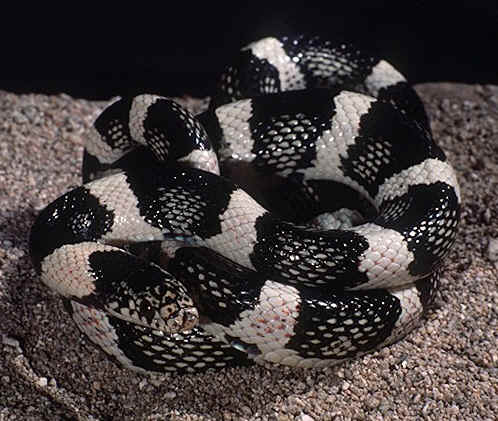
It's hard to believe snakes have bones
when they can get this twisted
up but they do!
A snake’s backbone is made up of many vertebrae attached to ribs. Humans have approximately 33 vertebrae and 24 ribs. Snakes have between 100-400 vertebrae with as many ribs attached! That is what makes them so flexible and helps them move along!
All those bones and the strong muscles protect the internal organs. The throat of the snake takes up the front one-third of the body. It leads to a really long stomach, which, like the throat, will stretch to the size of whatever the snake is eating. 
Snakes also have two long lungs, a long liver, kidneys and intestines. The last quarter of the snake has a small anal opening (they have to poop, you know!) covered by a scale called the anal plate, and the rest is tail made up of more bone. 


SUIT OF ARMOR !!

Snake Scales

Snakes bodies are covered with plates and scales. Without this protective armor snakes could not move over rough or hot surfaces like tree bark, rocks, and hot desert sand. Their scales are also nearly waterproof and help to keep the water out. Rough belly scales allow the snake to keep their grip on rough branches and to push off of surfaces when they need to move.
Scales are made up of layers of cells stacked one on top of the other. The outer cells are dead and protect the living ones underneath them.  A few times every year a snake will shed a layer of dead skin. The cells underneath are then ready to take over as the outer layer.
When a snake is ready to shed it’s eyes get cloudy and it is temporarily blinded. Why? Because snakes eyes do not have eyelids (that’s why they don’t blink) but instead are covered with a clear scale called a spectacle.  When a snake is ready to shed its old skin it will rub up against a rough surface, like a rock, to rip the skin and then slide right out. Just like taking off a sock!

SNAKES ARE REPTILES !!

Snakes belong to the animal group called reptiles. This group also includes crocodiles, lizards, and turtles. Reptiles are cold-blooded animals that raise their body temperature by lying in the sun or lower it by crawling into the shade. Their body temperature changes to the temperature of its surroundings. Because of this, snakes that live in colder climates must hibernate through the winter. They will find burrows or caves and fall into a deep sleep until the weather warms up enough for them.
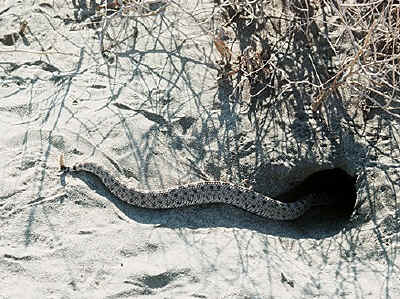
Rattlesnake entering its burrow.

There are more than 2,700 species of snakes in the world. They live almost everywhere, in deserts, forests, oceans, streams, and lakes. Snakes live on the ground, in trees, and in water. There are a few areas where snakes do not live. They cannot survive in places where the ground stays frozen all year around, such as in the high mountainous regions, above the Arctic Circle and Antarctica. Some islands, including Ireland and New Zealand, do not have snakes at all.